

15 Best Attractions in Fez: The Ultimate 2026 Morocco Travel Guide
Just after you reach the Blue Gate, somewhere before the leather tanneries, Fez is no longer a city but a presence. The scent of saffron and rawhide wafts through alleyways so narrow that loaded mules brush against both walls. A muezzin’s call ricochets off a carved cedar doorway older than Columbus himself. If there is only one city left on your Moroccan bucket list, let it be this one.
This guide covers all the main attractions in Fez, ranked and explained with a level of practicality you can only get from wandering these 9,000 alleys yourself. Whether as a standalone city break or combined with Morocco desert tours from Marrakech, you will leave this page knowing everything you need to know.
Top Of Every Morocco Itinerary: Why You Need Fez

Fez, which also happens to be Morocco’s oldest and arguably most beautiful of its four imperial cities, was designated a UNESCO World Heritage Site—though even that description feels inadequate. While Marrakech has embraced boutique hotels and Instagram culture, Fez remains gloriously and stubbornly true to itself. Medieval guilds still operate. Scholars still work within walls built in the 9th century. Tanners still stand in stone vats using techniques and recipes older than many European nations.
As the oldest of Morocco’s four imperial cities, Fez remains a cultural powerhouse, celebrated for its traditional craftsmanship, remarkable architecture, and extraordinary landmarks. Yet most visitors spend only a day here—a mistake this guide will help you avoid.
Experience the kingdom’s wonders with our best tours:
- 2 days to zagora from marrakesh
- 3 days desert tour from marrakesh to merzouga
- 4 days desert tour from marrakech
- grand morocco tours
Fes el Bali — A Dominant Medieval Medina

Nothing prepares you for your first step through the Blue Gate. Fes el Bali is considered the largest and most intricate medina in North Africa, where you navigate a stunning maze of more than 9,000 narrow alleyways lined with bustling souks, ancient tanneries, and beautifully decorated mosques.
Fes el Bali remains the world’s largest car-free urban area, filled with history and life. Around 100,000 people call these walls home. This is not a museum. It is a living neighborhood.
Pro Tip: Walk through Bab Bou Jeloud (the Blue Gate) and head down Talaa Kebira—the main artery of the medina—early in the morning while it is still quiet, before tour groups arrive. Hiring a local guide for the first couple of hours is money well spent; even experienced travelers get lost within minutes.
Chouara Tannery — The Icon You Can Smell Before You See It
The Chouara Tannery is the largest tannery in the city and is located in the oldest district of Fes el Bali, next to Saffarin Madrasa and near the river. It dates back to the 11th century.
It consists of a grid of circular stone vats, many filled with a milky mixture of cow urine, pigeon droppings, quicklime, salt, and water used to soften raw hides. Others contain natural dyes. Workers still use centuries-old techniques, soaking hides in stone troughs filled with dyes derived from saffron, mint, poppy, and indigo.
Take the sprig of mint they offer at the entrance—your nose will thank you.
Getting In: Ask any leather merchant around the surrounding terraces. They will usually guide you upstairs for a bird’s-eye view. There is no official admission fee; a small gratuity or purchase is customary but never required.
Al-Qarawiyyin University — The World’s Oldest University

The University of al-Qarawiyyin in Fez is recognized by both UNESCO and the Guinness Book of Records as the world’s oldest continually operating university. Founded in 859 AD by Fatima al-Fihriya, a wealthy woman from Fez, it began as a mosque before evolving into a center of higher learning.
Established between 857 and 859, al-Qarawiyyin became one of the most influential institutions in the Islamic world. The story of Fatima al-Fihriya alone makes this site remarkable: a woman who founded an institution that educated generations of scholars, philosophers, and mathematicians while much of Europe was still in the Dark Ages.
Non-Muslims cannot enter the mosque itself, although parts of the surrounding area and the atmospheric Qarawiyyin Quarter are accessible.
Bou Inania Madrasa — The Peak Of Marinid Architecture
Built between 1350 and 1355 by the Marinid Sultan Abu Inan Faris, the Bou Inania Madrasa became the most important madrasa of the Marinid dynasty and one of the most prestigious religious institutions in Morocco.
It is one of the few Islamic schools that also functions as a mosque and remains an active center of learning. As one of the very few Islamic religious sites in Morocco open to non-Muslims, it is the madrasa you should prioritize if you only visit one. Stunning cedar carvings, intricate stucco work, and brilliant zellige tiles decorate every surface.
The first time I entered the central courtyard at ten o’clock in the morning, sunlight struck the white marble fountain and reflected through the carved cedar galleries above, illuminating every corner of the space. Photographs cannot capture it. You simply have to stand there.
Don’t Miss: Directly opposite stands Dar al-Magana, one of the rarest surviving water clocks in the world. Although it no longer functions, seeing it feels like stepping into a forgotten era.
Dar Batha Museum — A Royal Palace Turned Museum
Located inside a 19th-century Andalusian-Moorish palace commissioned by Sultan Hassan I, the Dar Batha Museum showcases some of the finest examples of Fassi craftsmanship under one roof. Elegant galleries arranged around a fragrant garden display zellige tilework, carved plaster, textiles, manuscripts, and ceramics from across the region.
Dar Batha also provides valuable historical and artistic context for the craft traditions that define every souk stall in the medina, transforming shopping into cultural understanding.
Important Information: Generally open Wednesday to Monday from 8:30 AM to 4:30 PM. Hours may vary by season, so verify locally.
Medersa Attarine — A Hidden Gem Next To Al-Qarawiyyin
Built in the 14th century by the Merinid Sultan Abu Said Othman II, Attarine Madrasa stands so close to Al-Qarawiyyin that scholars once used it as an annex. It receives far fewer visitors than Bou Inania, allowing you to enjoy its central courtyard—an exquisite blend of carved stucco, cedar latticework, and geometric zellige—in near silence.
Its name translates as “Madrasa of the Perfume Sellers,” referencing the spice market that once occupied its entrance. Even today, there is a faint sweetness in the air, as though some things have never changed.
Mellah (Jewish Quarter) & Royal Palace Gates
Fes el Jedid—the “New Fez,” founded in the 13th century and still older than many European cities—is home to the Royal Palace and the Mellah, the historic Jewish quarter established in 1438. One of the earliest Mellahs in Morocco, it hosted a thriving Sephardic Jewish community for centuries.
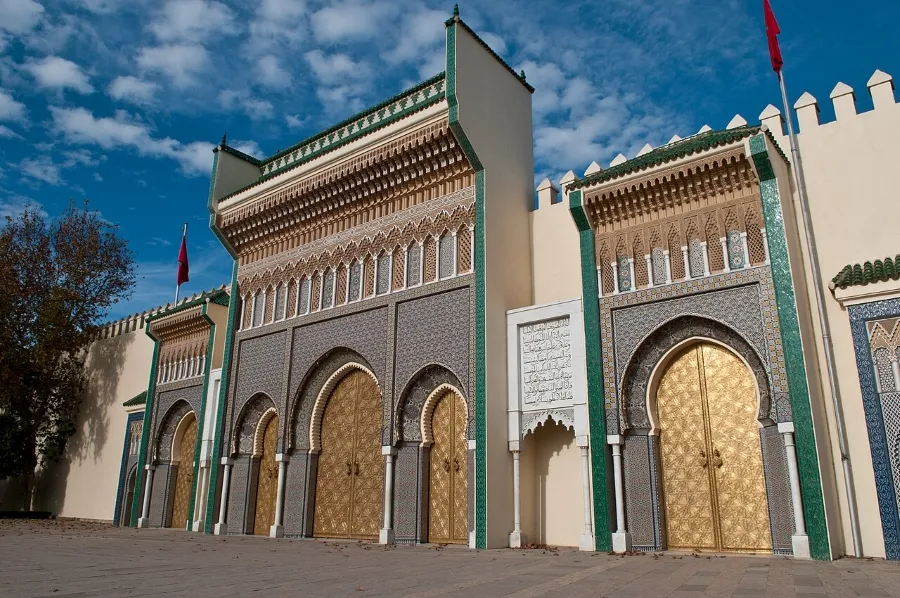
Among the most photographed landmarks in Morocco, the Royal Palace Gates (Dar el Makhzen) feature seven monumental brass doors decorated with geometric mosaic tilework and framed by hand-carved cedar panels. Although the palace remains an active royal residence, visitors may admire the gates and the spacious square before them.
Borj Nord — A Viewpoint Over The Medina
This 16th-century fortress now houses an impressive collection of weaponry, including a twelve-ton cannon and a nine-barreled pistol. More importantly, it offers one of the finest views of Fes el Bali, stretching across the valley below.
Visit during golden hour. The medina’s terracotta rooftops glow amber, minarets cast long shadows over the alleyways, and the vast scale of the city finally becomes clear from above.
Nejjarine Square & Museum Of Wood Arts
Perhaps the most picturesque corner of the medina, Nejjarine Square features a magnificent fountain decorated with hand-painted mosaic tiles and a beautifully restored caravanserai (fondouk), now home to the Museum of Wood Arts and Crafts.
Its three floors display carved doors, wooden astronomical instruments, mother-of-pearl-inlaid furniture, and tools once used by the city’s legendary woodworking guilds.
Like many hidden gems in Fez, the rooftop café offers exceptional views. Order a mint tea, put your phone away, and simply enjoy the medina stretching before you.
Jnan Sbil Gardens — The Green Lung Of The Medina
Located beside the medina walls, Jnan Sbil Gardens provide one of the few green escapes within this densely built city. Mosaic fountains, palm trees, and cypress-lined paths create a peaceful refuge from the intensity of the souks.
This is where locals come to relax in the evening and where children ride bicycles along spacious pathways.
If the medina begins to feel overwhelming, this is the perfect remedy. Spend an hour here before heading out for dinner.
Sidi Ahmed Tijani Mosque District & Spiritual Quarter
Fez has long been known as Morocco’s spiritual capital, and nowhere is this more evident than in the district surrounding the Tijani Mosque, the spiritual center of the Tijaniyya Sufi order, which has millions of followers throughout sub-Saharan Africa. Pilgrims from Senegal, Nigeria, and Mali visit throughout the year.
A walk through this quarter—past Quranic schools where children recite verses in unison, and scholars debate beneath archways—offers a glimpse into a living tradition of Islamic scholarship that no museum could ever replicate.
The Fassi Souks — Artisan Guilds Still in Operation
Unlike the more tourist-facing souks of Marrakech, the medina markets of Fez are still organized by trade, as they have been for a thousand years. Each quarter specializes in one craft:
- Souk Attarine — spices, essential oils, traditional remedies
- Souk Haddadine — blacksmiths, with the ring of hammers echoing off stone walls
- Souk Chouara — leather goods surrounding the famous tannery
- Souk Ain Allou — copper and brasswork, including the ornate lanterns sold across Morocco
- Souk Seffarine — brass and copper craftsmen working in an open square around a fountain
Bargaining is expected. So is patience. The best pieces go to those who sit for tea and conversation first.
Merenid Tombs — Sunset Above the City
Above Fes el Bali on the northern hills, the roofless ruins of 14th-century Merenid royal tombs offer what many consider the finest panoramic view in all of Morocco. Locals gather here each evening as the sun descends and the call to prayer rises from every minaret simultaneously — a stereo experience that reverberates across the valley.
The tombs themselves are modest; the view is not. Arrive 45 minutes before sunset and stay until the sky goes purple.
Hammam Experience — Authentic Fassi Ritual
Every neighborhood in the medina has its own hammam, and using one is among the most authentic things a visitor can do in Morocco. Rfissa, Fez’s signature dish, and the hammam tradition together define daily Fassi life. The Hammam Sidi Azzouz, just inside the medina, has operated for centuries and welcomes visitors at designated hours.
Bring your own flip-flops, accept the kessa (exfoliating mitt) offered, and surrender to a ritual that has structured Moroccan social life since the medieval period.
Day Trips from Fez — Meknes, Volubilis & Chefchaouen
Fez’s location makes it a natural base for some of Morocco’s most spectacular day trips:
- Meknes (1 hour): The other imperial city, less visited and less crowded, with a monumental granary (Heri es-Souani) that could hold 1,000 horses.
- Volubilis (1.5 hours): Morocco’s best-preserved Roman ruins, with intact mosaics still bright after 1,800 years.
- Chefchaouen (2.5 hours): The famous Blue City, where every alley is painted in shades of cobalt and sky blue.
How to Get to Fez from Marrakech
The most practical route between Morocco’s two most visited cities is by ONCF train (approximately 7–8 hours with one change at Casablanca Voyageurs) or by CTM coach (similar duration, direct). Many travelers wisely opt for a private multi-day tour that combines both cities with the Sahara in between.
Our Morocco desert tours from Marrakech include Fez as either a starting or ending point, combining the medina experience with the dunes of Erg Chebbi in a seamless itinerary.
When to Visit Fez
| Season | Temperature | Crowd Level | Verdict |
| March–May | 18–26°C | Moderate | ✅ Best time |
| Sept–Nov | 20–28°C | Moderate | ✅ Excellent |
| Dec–Feb | 8–15°C | Low | ✅ Atmospheric |
| June–Aug | 35–40°C | High | ⚠️ Hot, busy |
Spring and early autumn strike the ideal balance: comfortable temperatures for walking the medina, manageable crowds, and the kind of soft light that makes every alleyway photograph look like a painting.
How Many Days Do You Need in Fez?
- 1 day: The essential circuit — Blue Gate, Chouara Tannery, Bou Inania, Al-Qarawiyyin exterior, Nejjarine Square, Merenid Tombs at sunset.
- 2 days: Add Dar Batha, Attarine Madrasa, Mellah, Royal Palace Gates, Jnan Sbil, a hammam, and a cooking class.
- 3+ days: Day trips to Meknes and Volubilis, deeper souk exploration, full tannery quarter immersion.
Two days is enough time to enjoy all of the top attractions in Fes without feeling too rushed. If you have more time in the city, you could also do some cool Fes day trips.
Practical Tips for Visiting Fez’s Attractions
- Hire a licensed guide for at least half a day. The medina will disorient you within minutes, and a good guide adds layers of historical context that no article can replicate.
- Start early. The tanneries are most active and atmospheric before 10 AM. The souks are best before noon.
- Wear comfortable, closed-toe shoes. Cobblestones, uneven surfaces, and centuries-old drainage channels.
- Carry small bills. Many artisans and hammam operators work cash-only.
- Respect religious sites. Dress modestly (shoulders and knees covered), remove shoes where indicated, and ask before photographing people.
- Book accommodation inside the medina. Waking up inside the walls — to the call to prayer and the sound of the city stirring — is itself one of the top experiences in Fez.
Our Ultimate Morocco Travel Guides & Expert Resources
Planning beyond Fez? These guides complete your Morocco journey:
- Private Morocco Desert Tours: Tailored private desert tour morocco for travelers seeking exclusivity, custom itineraries, and genuine Saharan experiences far from the tourist trail.
- Private Tours in Morocco: Discover our private guided Morocco experiences and custom-built itineraries designed around your schedule, pace, and interests.
- Day Trips from Marrakech: Short on time? Explore the best Marrakech day trips and desert excursions — from the Ourika Valley to the Ait Benhaddou Kasbah.
- All-Inclusive Morocco Vacation: Stress-free planning with our all-inclusive Morocco vacation packages — accommodation, transport, guides, and meals handled.
- Best Luxury Morocco Tours: Experience the pinnacle of travel with deluxe Morocco trips combining riad stays, private transport, and curated cultural experiences.
- Marrakech Desert Tours 2026 Guide: Everything you need for your marrakech desert trips — timing, packing, camel trekking logistics, and which dunes are worth the journey.
- Morocco Tours from Casablanca: The perfect starting point for Morocco desert tours from Casablanca, connecting the coastal city to the imperial heartland.
- Desert Safari Morocco: Adventure awaits with a high-energy Morocco desert safari — dune boarding, quad biking, and overnight camps under the stars.
- Fly to Morocco from USA: Learn the best routes, airlines, and layover strategies to get to Morocco from the USA in 2026.
- Tours to Morocco from USA: Curated Morocco trips from USA for North American travelers, built around flight schedules and American vacation lengths.
- Sightseeing Agadir: Explore Morocco’s Atlantic coast with our guide to sightseeing in Agadir — beaches, the Kasbah, and the Souss Valley beyond.
- Half Day Tour of Marrakech: A quick dive into history with a Marrakech half-day tour — the Medina, Jemaa el-Fna, and the souks in four focused hours.
- Morocco Flag Meaning: Understand the culture and history behind the Moroccan flag — the green pentagram on red, and what it represents for the nation.
Frequently Asked Questions About Attractions in Fez
What is Fez most famous for?
Fez is most famous for its medieval medina (Fes el Bali), the Chouara Tannery, the world’s oldest university (Al-Qarawiyyin), and the Bou Inania Madrasa. It is Morocco’s spiritual and intellectual capital, a living city where medieval craft traditions remain active.
Is Fez or Marrakech better for culture?
Both cities are culturally rich, but Fez offers a more authentically preserved medieval atmosphere. Marrakech is more developed for international tourism; Fez retains a rawer, less curated character. Ideally, visit both — and pair them with a Morocco desert tour in between.
How many days should I spend in Fez?
Two days covers the essential attractions comfortably. Three days allows for day trips to Meknes, Volubilis, or Chefchaouen.
Can non-Muslims visit Fez’s mosques?
Most mosques in Fez, including Al-Qarawiyyin, are closed to non-Muslims for interior visits. However, the Bou Inania Madrasa is a notable exception — one of the few Islamic religious buildings in Morocco open to all visitors.
Do I need a guide in Fez?
Not legally, but practically: yes, at least for half a day. The medina is a genuine labyrinth. A licensed guide provides safety, context, and access to artisan workshops not visible from the street.
What is the best time to visit the Chouara Tannery?
Early morning (before 10 AM) is when the tannery is most active and the light is best for photographs. The smell is intense year-round; the complimentary mint sprig helps.
Is Fez safe for tourists?
Yes. Fez is generally safe for travelers. The medina has a high density of people and activity, which naturally deters petty crime. Be alert to unofficial “guides” who may offer to help and then demand payment; politely decline if you have not agreed on terms.
What food should I try in Fez?
Rfissa (shredded msemen flatbread with chicken, lentils, and fenugreek sauce) and Pastilla (sweet-savory phyllo pastry filled with pigeon or chicken, almonds, and cinnamon, dusted with powdered sugar) are the signature dishes of Fassi cuisine. Both are best experienced in a family-run restaurant inside the medina.
How do I get from Marrakech to Fez?
By train (via Casablanca, approximately 7–8 hours), by CTM bus (direct, similar duration), or by private guided tour — the most comfortable option and one that includes sights along the route.
Can I combine Fez with a desert tour?
Absolutely. Fez–Merzouga–Marrakech (or the reverse) is one of Morocco’s classic routes. Our Morocco desert trips include this circuit with private transport, expert guides, and luxury desert camp accommodation.
Conclusion: Fez Is Morocco’s Greatest Attraction
Every city in Morocco rewards the visitor. But the attractions in Fez reward them differently — not with photogenic luxury or curated spectacle, but with something rarer: genuine continuity. The tanner dyeing leather in the same vat his great-grandfather used. The student memorizing the same Quranic verses in the same school, surrounded by the same carved cedar, that scholars have filled for eleven centuries.
Come to Fez with comfortable shoes, a loose schedule, and the willingness to get pleasantly lost. Then, when the medina has had its say, follow the trade routes south — the same ones medieval caravans traveled — to the dunes of Erg Chebbi and the vast silence of the Sahara.
Ready to build the complete Morocco journey?
Our Marrakech desert tours pair seamlessly with a Fez city stay. Contact us today to design your custom 2026 Saharan adventure.
📅 Book Your 2026 Morocco Adventure
Plan Your Custom Saharan Itinerary → moroccodeserttrips.com Private tours · All-inclusive packages · Expert local guides
Meet the Expert
Authored by the Morocco Desert Trips Travel Team — local guides and travel specialists based in Marrakech, with over a decade of experience leading private tours across Morocco’s imperial cities, High Atlas passes, and Saharan erg fields. Our team has walked every alley described in this guide, eaten in the restaurants we recommend, and spent nights in the desert camps we book for our clients. We write what we know — because we live it.
See more
Last Minute Deals
- Quality4
- Location4
- Amenities4
- Services2
- Price5
Ancient Wonders: Book Your Moulay Idriss & Volubilis Day Tour from Fes
- Quality5
- Location5
- Amenities5
- Services5
- Price4
Agafay Sunset Tour: Jeep of Road With Camel Ride and Tea in a Nomad’s Tent
- Quality4
- Location4
- Amenities4
- Services2
- Price5
5 Days from Marrakesh to Merzouga and Erg Chebbi dunes
- Quality4
- Location4
- Amenities4
- Services2
- Price5